The competition between Nvidia and AMD has evolved far beyond traditional PC hardware. In 2026, this rivalry is no longer mainly about gaming graphics cards or desktop processors. Instead, it is centered on artificial intelligence, data center infrastructure, and next-generation chip architectures.
This shift matters because it influences some of the most important technological foundations of the modern economy. AI development, cloud computing expansion, enterprise digital transformation, and even global tech leadership are all shaped by how these two companies perform in the semiconductor market.
For investors, analysts, and technology leaders, understanding Nvidia vs AMD chip sales provides a clear picture of where the semiconductor industry is heading and who is setting the pace of innovation.
The Big Shift: From Gaming to AI-Driven Revenue
Over the past decade, both Nvidia and AMD relied heavily on gaming as a core revenue stream. However, the market structure has changed significantly as AI has become the primary driver of growth.
NVIDIA’s Transformation Into an AI Powerhouse
NVIDIA has successfully repositioned itself as a leader in AI computing. The company now generates a substantial portion of its revenue from data center operations rather than gaming hardware. Its GPUs are widely used for training large-scale AI models, powering cloud platforms, and supporting generative AI applications.
This transformation reflects a strategic shift toward high-performance computing and enterprise-scale solutions. NVIDIA’s early investment in AI infrastructure has allowed it to scale faster than its competitors.
AMD’s Expanding Role in Data Centers and AI
AMD has also expanded beyond gaming into enterprise and AI markets. The company has strengthened its position with EPYC server CPUs and Instinct AI accelerators, targeting data center workloads and enterprise clients.
While AMD’s progress is steady, its transition into AI leadership is still in development compared to Nvidia’s more established ecosystem.
Nvidia vs AMD Chip Sales: Market Share Breakdown
Market share trends in 2026 clearly show a divided landscape between dominance and growth.
GPU Market Leadership
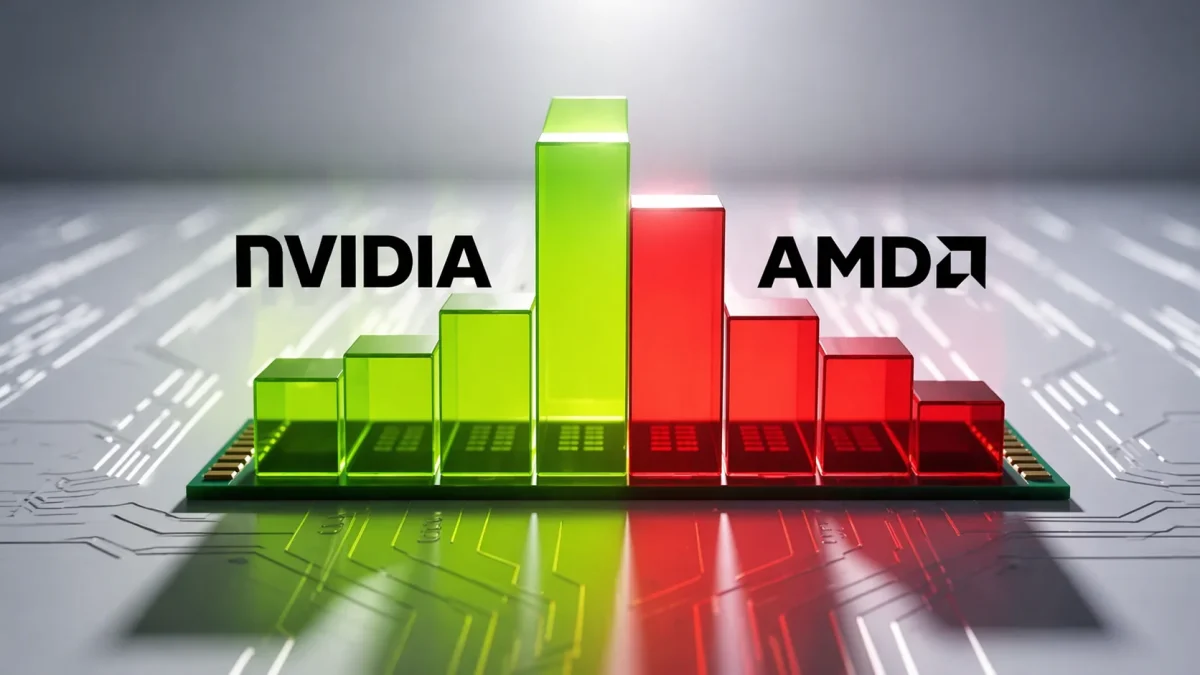
In the high-performance GPU segment, Nvidia maintains a commanding position. Its market share is estimated at 75%-85%, driven by strong demand for AI and professional computing workloads. AMD holds a smaller share but continues to compete effectively in mid-range and value-oriented segments.
AI Accelerator Market Dynamics
The AI accelerator market further highlights the gap between the two companies. NVIDIA leads decisively, controlling the majority of enterprise AI infrastructure deployments. AMD, while improving its presence, is still working to scale adoption of its AI-focused chips.
CPU Market Strength for AMD
Unlike the GPU market, the CPU market tells a different story. AMD has gained significant ground in server and desktop processors through its Ryzen and EPYC product lines. This remains one of its strongest competitive advantages in the semiconductor space.
The key takeaway is clear: AMD is more diversified across product categories, while Nvidia is highly specialized in AI and accelerated computing.
AI Revenue War: Why Nvidia Leads the Market
The most important factor in Nvidia vs AMD chip sales is AI-driven revenue. This is where the gap between the two companies becomes most visible.
NVIDIA’s AI Revenue Engine
NVIDIA generates massive revenue from data center GPUs, including the H100 series and its newer Blackwell architecture. These chips power AI training and inference workloads, as well as high-performance computing systems used by major cloud providers.
A key strength of Nvidia is its ecosystem. The CUDA software platform creates a tightly integrated environment for developers, making it difficult for customers to switch to alternative solutions. This software advantage significantly strengthens Nvidia’s long-term market position.
AMD’s AI Growth Strategy
AMD is investing heavily in its Instinct GPU series and open-source software frameworks designed to compete with CUDA. The company also emphasizes cost efficiency, offering competitive pricing to attract enterprise customers.
Although AMD is making progress, it still faces challenges in ecosystem maturity and developer adoption compared to Nvidia.
The Blackwell Impact: A Major Turning Point
One of the most significant developments shaping the 2026 semiconductor market is Nvidia’s Blackwell architecture.
What Blackwell Represents
Blackwell is a next-generation GPU architecture designed by Nvidia to enhance AI performance, efficiency, and scalability. It is specifically optimized for large-scale AI workloads, including both training and inference tasks.
Why Blackwell Matters for the Industry
The impact of Blackwell extends beyond performance improvements. It reduces per-AI-operation computing costs, improves energy efficiency, and increases processing speed for enterprise workloads. These advantages make it highly attractive to cloud providers and AI companies.
Market Implications
The introduction of Blackwell is expected to strengthen Nvidia’s dominance in the data center market and widen the gap between Nvidia and AMD in AI computing. It reinforces Nvidia’s leadership position at a time when demand for AI infrastructure is rapidly accelerating.
AMD’s Competitive Strategy: A Value-Focused Approach
Despite Nvidia’s dominance, AMD continues to compete through a different strategic approach focused on value and flexibility.
Key Strategic Initiatives
AMD is targeting enterprise customers with its MI300 series GPUs and integrated CPU-GPU solutions. The company aims to provide alternatives that balance performance and affordability.
Strengths in the Market
AMD’s key advantages include strong CPU leadership, competitive pricing, and a flexible architecture that appeals to cost-conscious enterprises. These strengths allow it to remain a serious competitor in multiple segments.
Ongoing Challenges
However, AMD still faces limitations in the software ecosystem and in enterprise adoption compared to Nvidia. Its AI platform is growing but has not yet reached the same level of industry-standardization.
Data Centers: The Core of the Semiconductor Battle
The real competition in Nvidia vs AMD chip sales is happening in data centers, which have become the foundation of modern AI infrastructure.

NVIDIA’s Dominant Position
NVIDIA plays a central role in powering hyperscale data centers and cloud AI platforms. Its GPUs are widely deployed across major technology companies for AI training and inference workloads.
AMD’s Growing Opportunity
AMD is gradually increasing its presence in data centers through EPYC processors and integrated solutions. The company is focusing on delivering cost-effective alternatives for enterprise workloads.
The outcome of this segment will largely determine future leadership in the AI economy.
Gaming Segment: Still Relevant but No Longer Dominant
Although gaming remains an important market, it is no longer the primary driver of growth for either company.
NVIDIA in Gaming
NVIDIA continues to lead the high-end gaming GPU market with advanced features such as ray tracing and AI-enhanced graphics rendering. It maintains strong brand loyalty among gamers.
AMD in Gaming
AMD remains highly competitive in mid-range gaming GPUs and maintains a strong presence in gaming consoles. Its pricing strategy gives it an advantage in value-focused segments. Despite this, gaming has become secondary to AI and data center revenue streams.
Software Ecosystem: Nvidia’s Structural Advantage
One of the most important yet less visible factors in this competition is software.
CUDA Ecosystem Advantage
NVIDIA benefits from its CUDA platform, which is widely used in AI development. This ecosystem creates strong dependency among developers and enterprises, making migration to other platforms difficult.
AMD’s Open-Source Approach
AMD relies on open-source frameworks such as ROCm. While this approach offers flexibility, it has not yet reached the same level of industry adoption as CUDA. Software leadership plays a crucial role in long-term market dominance.
Pricing Strategy: Premium vs Value Positioning
The two companies follow very different pricing strategies.
NVIDIA focuses on premium pricing, high performance, and ecosystem lock-in. This strategy results in higher profit margins and strong enterprise demand.
AMD, on the other hand, emphasizes affordability and performance efficiency. This allows it to attract customers who prioritize cost optimization over ecosystem integration.

Stock Market Perspective
The financial markets closely track the performance of both companies as indicators of AI industry growth.
NVDA is often viewed as the primary beneficiary of the AI boom, driven by strong revenue growth and investor confidence in its dominance.
AMD is considered a growth-oriented stock with higher volatility but significant long-term potential.
Future Outlook
Looking ahead, the outlook remains divided between dominance and competition.
NVIDIA is expected to maintain leadership in AI computing, data centers, and high-performance GPUs, especially as the Blackwell architecture continues to gain adoption.
AMD is likely to grow steadily in CPUs, expand its AI presence, and compete aggressively on pricing and enterprise solutions.
Overall, Nvidia is positioned as the market leader, while AMD continues to strengthen its role as a capable and evolving challenger.
Final Thoughts
In conclusion, Nvidia currently leads the semiconductor industry in AI revenue, data center dominance, and high-performance computing. AMD remains a strong competitor, with solid CPU growth and expanding AI capabilities.
The Blackwell architecture further strengthens Nvidia’s advantage, but AMD remains relevant through diversification and pricing strategy.
The competition is no longer just about GPUs; it is about controlling the infrastructure of the AI era.
Frequently Asked Questions (FAQs)
Who leads the chip market in 2026, Nvidia or AMD?
NVIDIA leads the overall AI and data center chip market in 2026, driven by its dominance in high-performance GPUs and AI infrastructure. AMD remains a strong competitor but holds a smaller share in AI-focused chip sales.
Why is Nvidia ahead of AMD in AI chip sales?
NVIDIA’s lead comes from its early investment in AI computing, its CUDA software ecosystem, and strong partnerships with cloud providers. These factors create a powerful ecosystem that is difficult for AMD to quickly replace or match.
What is Blackwell, and how does it impact Nvidia’s growth?
Blackwell is Nvidia’s next-generation GPU architecture designed for AI workloads. It improves performance, energy efficiency, and scalability, helping Nvidia strengthen its dominance in data centers and AI computing markets.
Can AMD compete with Nvidia in the AI market?
Yes, but indirectly. AMD is competing through its Instinct AI GPUs, EPYC CPUs, and competitive pricing. However, it still faces challenges in software ecosystem maturity and large-scale enterprise adoption compared to Nvidia.
Which company is better for long-term growth: Nvidia or AMD?
NVIDIA currently leads in AI dominance and revenue, while AMD offers growth potential through diversification and value-based pricing. The better choice depends on whether the focus is stability (Nvidia) or expansion potential (AMD).